
Measurement of Live Biomass in wastewater
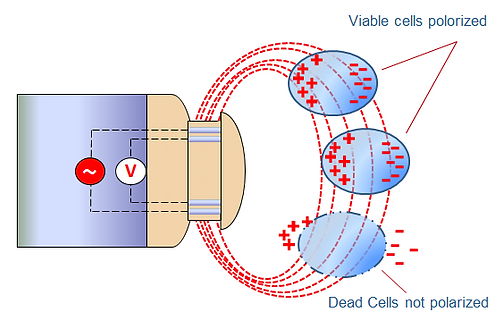
LIVE biomass measurement using Capacitance sensors utilises dielectric based on biological cells' ability to accumulate charges when exposed to electrical fields. Dead cells with permeabilized plasma membranes, cell debris, non-biological particles are not detected. Fouling is eliminated with “cleaning pulses” using frequency discharges at electrodes.
This highly sensitive technology is typically used in single species, highly controlled environments with known culture media. Wastewater monitoring is much more complex and was once thought impossible.
The System measures an electrical property of cell suspensions called Capacitance. Research has demonstrated a correlation between this property and live biomass.
Electrical capacitance is measured in the SI unit farads, or picofarads, usually quoted in pF/cm. As a rule of thumb, 1 pF/cm equates to 1 gram/L dry weight for microbial or 1x10 cells/millilitre of larger live cells.
The equipment also measures the Conductivity (millisiemens per centimetre (mS/cm)) and Temperature (O ). Conductivity is indicative of the production or c utilisation of ions by the cell population, but in the case of WWTP’s may vary significantly with changing load conditions. Monitoring and compensation are important as Conductivity and Temperature are linked to Capacitance.

Previous Proof of Concept (Innovate grant) project: Established microbes of different sizes are seen differently by capacitance depending on sensor frequency.
Confidential proprietary algorithms incorporate multiple frequencies to compensate for microbial variability between sites.
Compensation factors for conductivity and temperature combine with above to deliver almost 100% correlation to Biomass concentration.
Sensitivity is validated to be approporiate to the operational range of typical Wastewater Treatment Plants.